
Cross-team coordination workflow guide for SMBs



TL;DR:
- Coordination failures are caused by broken workflows, not communication problems, leading to delays in project delivery.
- Using the RACI matrix clarifies roles, assigns clear ownership, and reduces unnecessary meetings, improving efficiency.
- Automating dependency tracking and handoffs through integrated tools streamlines cross-team workflows, ensuring predictable execution.
When a product launch slips because engineering was waiting on design, who was waiting on copy, who was waiting on a legal review that nobody knew was required — that is not a communication problem. That is a broken cross-team coordination workflow. For project managers and operations leads at growing companies, this kind of cascading delay is the single biggest threat to delivery predictability, and fixing it requires more than a stand-up meeting or a new chat tool.
Table of Contents
- Understanding roles and responsibilities with the RACI matrix
- Mapping and managing cross-team dependencies effectively
- Optimizing handoffs for smoother cross-team workflows
- Integrating RACI with digital workflows for efficiency
- Measuring and verifying improved coordination workflows
- Why typical coordination fixes fall short and what really drives speed
- Streamline your cross-team workflows with TeamBuilt features
- Frequently asked questions
Key Takeaways
| Point | Details |
|---|---|
| Define clear roles | Use RACI to assign one accountable person and clarify responsibilities to prevent delays and confusion. |
| Map dependencies | Identify and track cross-team dependencies to uncover bottlenecks and optimize workflow timing. |
| Optimize handoffs | Formalize handoffs with clear acceptance criteria, accountability, and escalation rules to avoid delays. |
| Leverage automation | Integrate RACI with digital tools to reduce cognitive load and speed decision-making across teams. |
| Measure performance | Track dependency metrics regularly to verify improvements and guide ongoing workflow optimization. |
Understanding roles and responsibilities with the RACI matrix
To build a solid foundation for coordination, start by clarifying who owns what across teams using a proven framework. The RACI matrix (Responsible, Accountable, Consulted, Informed) is the most practical tool for this job. Each letter answers a different question: Who does the work? Who owns the outcome? Who provides input? Who just needs to know?
The RACI framework gives each task an explicit owner and approver so decisions don’t get revisited in every meeting. The critical rule is that “Accountable” must be one person. Assigning accountability to a team or two co-owners sounds fair but creates the exact bottleneck you’re trying to avoid. When no single person owns the final call, everyone waits.
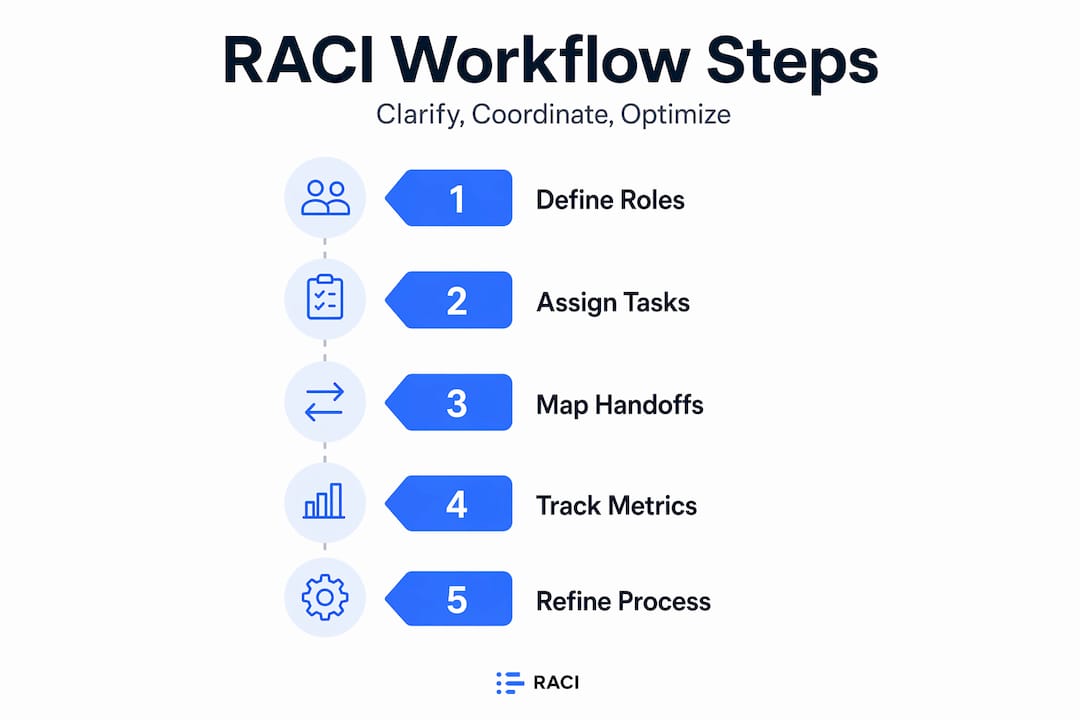
One overlooked benefit of RACI is what it reveals about your meeting calendar. Too many Consulted roles means too many people in rooms where they aren’t making decisions. Converting unnecessary C’s to I’s, and replacing those touchpoints with async updates, can eliminate entire recurring meetings. That’s a direct productivity gain that coordinated workflows boost productivity data consistently confirms.
Here is what a basic RACI definition covers per task:
- Responsible: The person or people doing the actual work
- Accountable: The single decision-maker and outcome owner (never a group)
- Consulted: Those whose expertise is needed before the task proceeds
- Informed: Those who need updates but don’t influence decisions
Pro Tip: Start your RACI with just 10 to 15 of your most critical cross-team tasks. Going too granular too fast creates a maintenance burden that teams abandon. Prove value at a small scale first, then expand.
Mapping and managing cross-team dependencies effectively
With clear roles established, the next step is understanding and managing how work flows between teams to prevent bottlenecks. Most coordination failures aren’t about effort. They’re about invisible handoffs and untracked dependencies that nobody owns until something breaks.
Start by mapping the actual handoffs and dependencies on your current projects. Don’t describe what should happen. Walk through what is actually happening: which team produces the output, which team consumes it, how long the gap between delivery and consumption typically is, and what happens when delivery is late.
A strategic dependency-management framework recommends tracking at least three metrics and using a threshold of more than 20% of active work blocked by other teams as a signal that you have a structural coordination problem, not just a one-time delay.
Step-by-step process for mapping dependencies:
- List all active projects and identify every team that touches them
- Draw the handoff sequence for each project from start to finish
- Label each handoff with the output type, expected timing, and receiving team
- Flag which handoffs have caused delays in the past three months
- Assign a dependency owner for each flagged handoff to monitor and escalate
Key dependency metrics to track:
| Metric | What it measures | Action threshold |
|---|---|---|
| Dependency wait time | Average delay from handoff request to completion | >2 days for recurring handoffs |
| Blocked work % | Percentage of active tasks blocked by another team | >20% indicates structural issue |
| Dependency volume by team | Number of incoming/outgoing dependencies per team | Imbalance signals overload |
Once you know where the bottlenecks live, create buffer times in your project schedule for high-volume dependency paths. Build explicit escalation paths so that a blocked task never sits silent for more than 24 hours. Use tools that coordinate teams effectively by sending automated alerts when dependency deadlines are approaching. The manual check-in model breaks at scale.

Pro Tip: Don’t try to fix every dependency at once. Identify your single highest-impact bottleneck, resolve it fully with a documented dependency contract, and then apply that template to the next one. Gradual expansion sticks better than organization-wide rollouts.
Reviewing workflow examples for SMBs from similar organizations is also useful at this stage for benchmarking your current state against what functional dependency management actually looks like.
Optimizing handoffs for smoother cross-team workflows
Once dependencies are identified, formalizing handoffs keeps work moving without costly context drops. A handoff without a defined structure is where your cross-team collaboration workflow quietly dies. Work gets passed without agreed acceptance criteria, the receiving team doesn’t know what “done” looks like from the sender’s perspective, and what follows is a loop of clarification emails and rescheduled reviews.
Effective handoffs require defined acceptance criteria, explicit stop rules, escalation triggers, and a named person who drives the handoff at the moment of transfer. Without that, context evaporates at the boundary between teams.
What a well-structured handoff includes:
- Clear inputs and outputs: Both sides agree on what is being delivered and in what format before work begins
- Acceptance criteria: The receiving team defines what “ready to accept” looks like, not the sending team
- A single driver: One person owns moving the handoff forward at the moment of transfer
- A single decider: One person can approve or reject the deliverable without committee consensus
- Stop rules: Predefined conditions that pause the handoff and trigger a review rather than forcing through incomplete work
- Escalation triggers: Automatic or manual flags when a handoff is delayed beyond a set threshold
The agency project workflows guide offers practical models for structuring these handoffs across client-facing and internal teams in fast-moving environments.
Pro Tip: Before a major product launch or system migration, run a rehearsal of your handoff sequence with the actual teams involved. Use a lower-stakes internal project to test whether the acceptance criteria are clear and the escalation paths actually work. You will find problems before they cost you.
Integrating RACI with digital workflows for efficiency
To further speed coordination, embed RACI directly into the tools your teams already use. A RACI matrix that lives in a spreadsheet reviewed quarterly has minimal impact. A RACI that is baked into your task management system, triggers automatic notifications, and enforces accountability gates changes daily behavior.
Embedding RACI into tools with automation cuts handoff latency, reduces cognitive load, and lowers the context switching that kills focused work. The efficiency gains are practical and measurable.
Tactics for making RACI operational in your tech stack:
- Dynamic role assignment: Tag tasks in your project tool with RACI roles so ownership is visible without opening a separate document
- Calendar API integration: Connect approver calendars to your workflow tool so you can see decision-maker availability before routing a task for approval
- CI/CD pipeline gates: For engineering and product teams, enforce accountability checkpoints in your deployment workflow so nothing ships without an assigned Accountable owner
- Async consult syncs: Replace broad standing meetings with short, purpose-specific consult sessions triggered only when a task enters the Consulted stage
“The teams that consistently ship on time are not the ones with the most meetings. They’re the ones where accountability is encoded into the system itself, not left to individual memory or good intentions.”
Pro Tip: Don’t restructure your entire workflow around RACI at once. Pick one sprint or one critical project task and instrument it fully. Review the results after two weeks, then expand the model. The teams that scale this best treat the first implementation as a proof-of-concept.
Workflow automation examples for project managers can help you identify which parts of your current process are best suited for RACI-based automation.
Measuring and verifying improved coordination workflows
Systematically measuring your coordination workflows confirms success and reveals where to improve next. Intuition about whether coordination is “better” is unreliable. You need numbers that tell you specifically which bottlenecks were resolved, which team is still overloaded, and whether your handoff protocols are actually being followed.
Step-by-step verification process:
- Define your baseline metrics before making changes: current wait times, blocked work %, and which teams generate the most coordination friction
- Set a measurement interval. Review coordination metrics every two weeks for the first three months
- Connect your project tools to a reporting dashboard so data is collected automatically, not manually
- Set threshold alerts. For example, if blocked work exceeds 20%, trigger a review of that team’s dependency contracts
- After each review, write a brief after-action note connecting the metric movement to a specific decision or change you made
Coordination health scorecard:
| Metric | Healthy range | Review trigger | Response |
|---|---|---|---|
| Dependency wait time | Under 2 days | Over 3 days average | Audit handoff process for that pair |
| Blocked work % | Under 15% | Over 20% | Redesign dependency contract |
| Dependency volume per team | Balanced across teams | One team >2x average | Reallocate work or add buffer |
| Decision latency | Under 1 day | Over 2 days | Schedule decision windows for Accountable person |
Tracking dependency wait time and blocked work percentage by team helps you identify structural coordination problems that need real intervention, not just encouragement to communicate better.
Metrics alone won’t tell you what to do. The after-action notes are where the learning happens. A spike in blocked work in week three might be explained by a new team member onboarding, a tool outage, or a policy change, context that the dashboard can’t capture on its own. For a deeper look at how measurement ties to overall performance, review how boost productivity and predictability work together in practice.
Why typical coordination fixes fall short and what really drives speed
Here is the hard truth most coordination guides skip: the most common responses to coordination failures, adding more meetings, buying another tool, creating another status report, reliably make things worse before they make anything better.
More meetings increase the overhead they are meant to reduce. A new tool without governance rules creates another inbox to ignore. Status reports without threshold-based escalations are read by nobody who needed them most.
Improving coordination requires measuring and redesigning dependency mechanics, not just adding meetings or tools. The root cause of most cross-team delays is not that people don’t care. It’s that the system doesn’t make the right action obvious, automatic, or unavoidable.
What actually moves the needle:
Dependency mechanics redesign. Map your real handoffs, measure wait times and blocked work %, and redesign the contracts between teams based on actual friction points, not perceived ones.
Executable handoffs. Vague handoffs are the single biggest source of rework at team boundaries. When acceptance criteria and escalation triggers are written down and assigned to a named driver, “we’re waiting on X team” becomes a trackable event, not a conversation.
Decision availability, not just decision rights. RACI tells you who is Accountable. It doesn’t guarantee that person is available when a decision is needed. Overloaded leads who are the Accountable owner on 12 simultaneous projects create invisible queues that never show up in your dependency metrics. The fix is scheduled decision windows, specific time blocks reserved for cross-team approvals, built into the calendar, not added ad hoc.
Escalation paths with teeth. An escalation process that routes to the same overloaded manager is not an escalation process. Build paths that go around bottlenecks to backup decision-makers when thresholds are breached.
The teams that ship consistently are not the ones with the best intentions. They are the ones whose systems make the right coordination behavior the default.
Streamline your cross-team workflows with TeamBuilt features
If this guide gave you a clear picture of where your coordination breaks down, the next challenge is implementing these changes without adding more manual overhead to your already full plate.
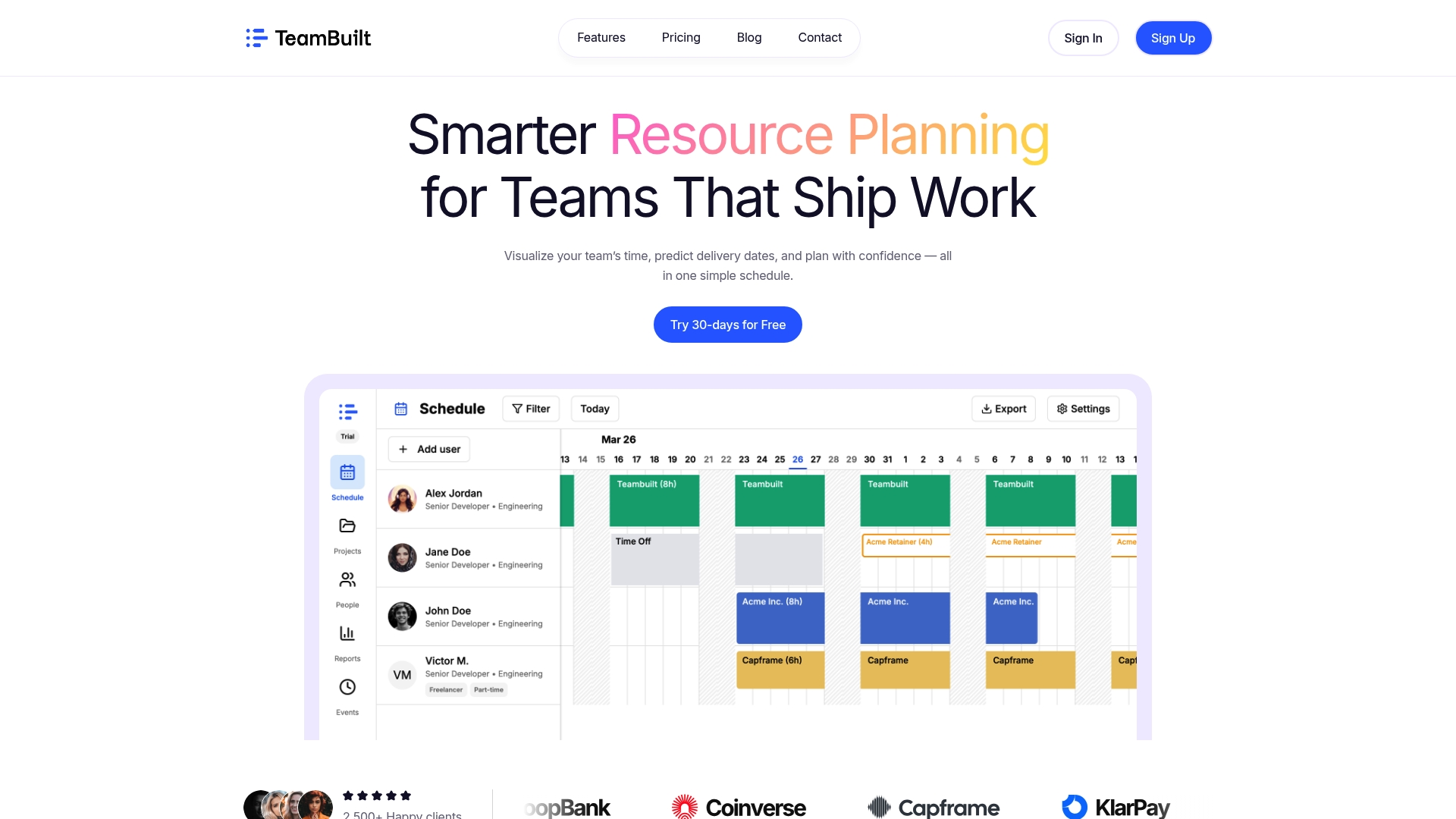
TeamBuilt is built for exactly this. The platform centralizes role assignments, dependency tracking, and handoff protocols so your cross-team coordination process lives in one place instead of scattered across spreadsheets, email threads, and chat channels. Automated alerts notify teams when dependency deadlines approach. Calendar syncing surfaces approver availability before tasks get stuck in a queue. Built-in dashboards track blocked work percentage, wait times, and bottleneck teams in real time, so you’re reviewing data, not collecting it. For growing startups and SMBs ready to replace reactive firefighting with a predictable delivery process, explore TeamBuilt’s resource planning features and see how centralized coordination translates directly into faster, more reliable execution.
Frequently asked questions
What is a cross-team coordination workflow?
It is a structured process that ensures tasks, decisions, and handoffs between multiple teams are clear, timely, and efficient to avoid delays and confusion.
How does the RACI matrix improve cross-team coordination?
RACI explicitly defines who is Responsible, Accountable, Consulted, and Informed for each task, which means fewer delays and less finger-pointing from unclear ownership and reduces unnecessary meetings by separating decision-makers from update recipients.
What are key metrics to track cross-team dependencies?
Critical metrics include dependency wait time, the percentage of blocked work, and the volume of dependencies per team. Tracking these three metrics helps identify structural coordination problems that require intervention, not just process reminders.
Why do too many Consulted roles cause problems in coordination?
Too many Consulted stakeholders increase meeting load and slow decision-making. Shifting stakeholders from Consulted to Informed reduces coordination overhead while still keeping people updated.
How can technology help improve RACI implementation?
Integrating RACI into digital tools automates accountability checks and matches approval tasks to available decision-makers. Embedding RACI with automation significantly cuts handoff latency and context switching, improving task resolution speed across teams.
Recommended