
HR team planning strategies for SMBs and startups



TL;DR:
- Many small and growing companies overlook the strategic role of HR in aligning people decisions with business goals. Effective HR planning, including workforce analysis and demand forecasting, prevents costly misalignments and supports sustainable growth. Utilizing simple tools and focusing on exceptional hires enables lean teams to execute high-impact strategies without overwhelming overhead.
Most founders and team leads think of HR as a support function: post a job, make an offer, handle paperwork. That narrow view costs growing businesses more than they realize. When HR operates reactively, teams scale chaotically, key roles get filled with the wrong people, and projects miss deadlines because no one tracked capacity against actual demand. Strategic HR team planning is what prevents those failures. It connects your business goals to the people decisions that execute them, and for startups and SMBs competing with fewer resources, that connection is the difference between sustainable growth and constant firefighting.
Table of Contents
- Why HR is the backbone of team planning
- Core steps of the HR team planning process
- Adapting HR team planning for startups and lean teams
- How data-driven HR planning drives results
- What most HR guides miss: Focus, flexibility, and the power of one great hire
- Ready to put smart HR team planning into action?
- Frequently asked questions
Key Takeaways
| Point | Details |
|---|---|
| Strategic HR is vital | HR’s role in team planning directly links business goals to people and resource decisions. |
| Process beats improvisation | A structured team planning process helps avoid common pitfalls and wasteful hiring. |
| Simplicity scales | Startups and SMBs do best with simple, regular planning—no need for complex tools. |
| Data drives results | Using data and metrics improves hiring, controls costs, and adapts teams quickly for growth. |
| Quality over quantity | One strong hire with proper onboarding is worth more than several rushed or mismatched hires. |
Why HR is the backbone of team planning
HR’s influence on team planning is routinely underestimated because its work happens before the visible stuff: before the new hire shows up, before the project kicks off, before the org chart changes. But that upstream work is exactly what determines whether your team can actually deliver.
Workforce planning means HR assesses current capabilities, forecasts future needs based on business strategy, analyzes gaps, and develops action plans that include hiring, training, and restructuring. That is not administrative work. That is strategic planning with direct revenue implications.
When a growing SaaS startup hires three engineers in a quarter without a structured plan, they often discover six months later that two of those roles were redundant and one critical backend skill was never filled. The result: wasted payroll, delayed launches, and team frustration. A structured HR planning process catches that misalignment before it becomes expensive.
“HR is not just the people who hire people. At its best, HR is the function that ensures every team member is in the right role, at the right time, doing work that moves the business forward.”
Here is what HR-led planning concretely does for your teams:
- Resource alignment: Maps headcount to project timelines and business priorities, so you are not over-staffed in one area and stretched thin in another.
- Risk mitigation: Identifies single points of failure (one person owning a critical skill with no backup) before they become crises.
- Talent optimization: Matches skills to roles based on actual project demands, not just available headcount.
- Cost control: Prevents the budget bleed of reactive hiring, which almost always costs more than planned hiring.
- Team effectiveness: Reduces burnout by catching overallocation before it affects delivery.
For SMBs that want to move faster with smaller teams, investing in planning tools for SMBs is a practical way to make these processes manageable without a large HR department.
Core steps of the HR team planning process
Understanding why HR drives planning is useful. Knowing how to run the process is what actually changes outcomes. The standard HR planning cycle follows five clear steps: analyze current workforce supply, forecast demand, conduct a gap analysis, build an action plan covering recruiting, training, and retention, then monitor and adjust continuously.
Here is how each step works in practice:
- Analyze current supply. Take stock of your existing team: roles, skills, capacity, and utilization rates. For a 20-person startup, this might be a simple spreadsheet. For a 150-person SMB, it requires a dedicated tool. Either way, you cannot plan what you have not mapped.
- Forecast demand. Look 3 to 12 months ahead. What projects are coming? What revenue targets require new capabilities? Which current team members might leave? Demand forecasting ties HR directly to the business roadmap, not just the current org chart.
- Conduct a gap analysis. Compare supply to demand. Where are you short on capacity? Where do you have skill gaps that hiring or training needs to close? This step turns a vague sense of “we need more people” into a specific, prioritized list.
- Build an action plan. This is where decisions get made: who to recruit, who to upskill, which contractors to bring in for short-term peaks, and how to restructure existing teams for better efficiency.
- Monitor and adjust. Plans go stale fast, especially in startups. Build in a quarterly review cadence, or more frequently for high-growth environments, so your plan reflects reality rather than a snapshot from six months ago.
Smart resource planning for SMBs follows the same structure, adapted for leaner operations. And modern team scheduling workflows make steps one and two much faster by giving you real-time visibility into who is available and when.
| Planning factor | Startups (under 50 people) | Mature SMBs (50 to 200 people) |
|---|---|---|
| Time horizon | 1 to 3 months | 6 to 12 months |
| Tools used | Spreadsheets, simple calendars | HRIS, resource planning platforms |
| Complexity | Low, role-based | Moderate, team and project-based |
| Review cadence | Monthly or quarterly | Quarterly or biannual |
| Scenario planning | Basic (best/worst case) | Multi-scenario with triggers |
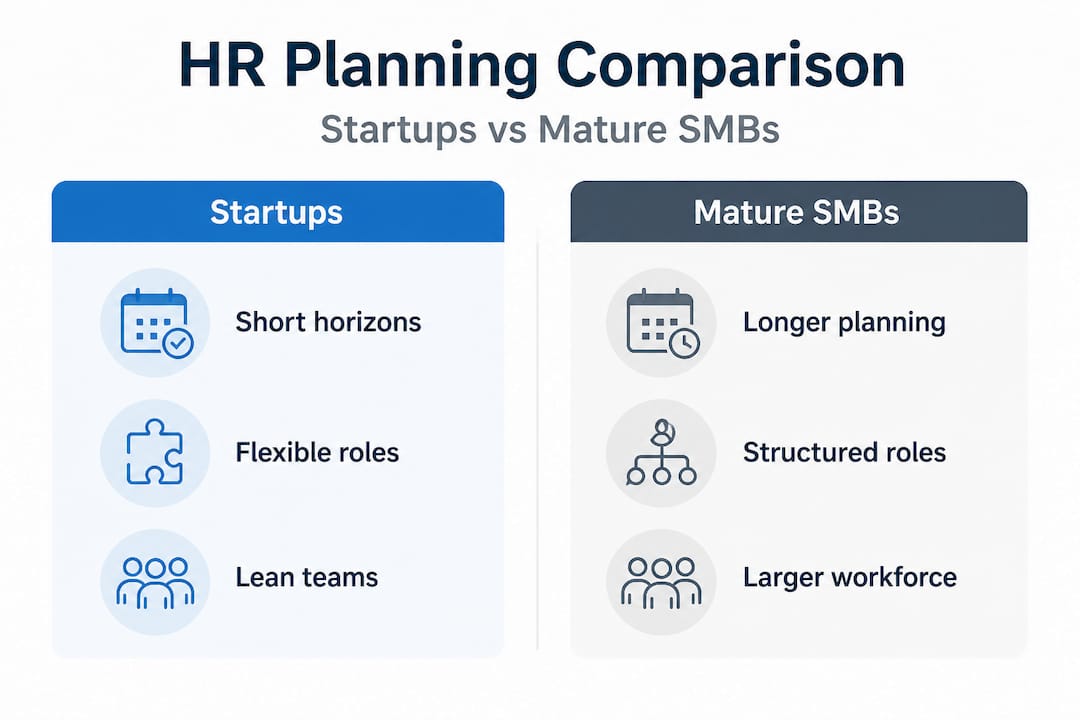
Tools like AI talent matching are increasingly being used to speed up the demand forecasting step, particularly for high-growth companies that need to scale hiring quickly without sacrificing fit.

Pro Tip: If your team is under 30 people, resist the urge to implement a complex HRIS from day one. Start with a structured quarterly review using a shared spreadsheet or a lightweight planning tool. Build the habit before you build the system.
Adapting HR team planning for startups and lean teams
Small businesses and startups under 50 employees benefit most from keeping HR planning simple: quarterly hiring plans, role prioritization, and a straightforward capacity assessment, all without requiring sophisticated enterprise tools.
That simplicity is a feature, not a limitation. When you have fewer than 50 people, every hire has an outsized impact on team culture, workload distribution, and output quality. Getting one hire right matters enormously. Getting it wrong sets you back months.
Here is a sample quarterly capacity plan for a 25-person startup to illustrate what practical HR planning looks like at this scale:
| Role | Current headcount | Q3 need | Gap | Action |
|---|---|---|---|---|
| Frontend developer | 2 | 3 | 1 | Hire by July |
| Customer success | 1 | 2 | 1 | Hire by August |
| DevOps | 0.5 (fractional) | 1 | 0.5 | Extend contract or hire |
| Product manager | 1 | 1 | 0 | No action needed |
| Marketing | 1 | 1.5 | 0.5 | Contractor for campaign |
That table is not fancy. But it forces three critical decisions: what do we actually need, when do we need it, and how will we get there. Most startups skip this step and hire based on gut feel, which explains why so many end up with imbalanced teams.
Common pitfalls lean teams fall into during this process:
- Overhiring in one function while leaving critical gaps in others (often engineering or customer success)
- Skipping onboarding because the team is “too busy,” which means new hires take twice as long to become productive
- Hiring for availability rather than fit, filling a role with whoever is ready rather than whoever is right
- Ignoring attrition risk by not identifying flight-risk employees or roles that depend on a single person
A solid recruitment checklist helps lean teams stay disciplined even when the pace is fast. Check out these SMB team workflow examples to see how other small teams structure their hiring and onboarding cycles.
Pro Tip: One well-onboarded hire who ramps in 30 days beats three rushed hires who each take 90 days to get up to speed. Time-to-productivity matters more than headcount in lean teams. Prioritize the role that unlocks the most downstream capacity, then hire for it carefully.
How data-driven HR planning drives results
Strategic HR planning sounds good in theory. What does it actually produce? The numbers are compelling.
HR budgets are rising significantly: the median HR expense is now 2.4% of operating expenses, up from 1.2% in 2017, with spending reaching $2,479 per full-time employee (FTE), nearly double the 2022 figure, and an HR-to-employee ratio of 1.98 per 100 workers. Organizations are investing more in HR because they are seeing returns.
The most direct evidence comes from a data-driven budgeting case study in which structured planning reduced payroll variance from 12% to 4%, saved $3 million in costs, and accelerated budget approvals. That is not a marginal improvement. That is a structural shift in how predictably a business can operate.
Here are three concrete ways data-driven HR planning delivers measurable payoff:
- Cost control through precision. When you forecast headcount needs accurately, you avoid the compounding costs of emergency hiring: recruiter fees, signing bonuses, and the inevitable productivity dip when someone joins a team that is not ready for them. Planned hiring consistently costs less per hire than reactive hiring.
- Better hires through structured criteria. Data-driven planning forces you to define role requirements before you post a job. Teams that know exactly what skill gaps they are filling make better hiring decisions than teams hiring on urgency alone. AI in HR recruitment is extending this advantage by screening candidates against structured criteria at scale.
- Agility through early warning signals. When you track utilization and capacity regularly, you catch problems early. A team trending toward 110% utilization three months out gives you time to act. Without data, you find out when people start missing deadlines.
The insight that separates good HR planning from great HR planning is this: most small companies live in operational mode, solving the problem in front of them right now. Project delivery best practices consistently show that teams with a forward-looking planning cadence, even a simple one, deliver more predictably than those that don’t. Strategic planning does not require a 50-person HR department. It requires consistent habits and the right data.
What most HR guides miss: Focus, flexibility, and the power of one great hire
Most HR guides for startups tell you to build a people operations function, implement an HRIS, create competency frameworks, and run structured performance reviews. That advice is not wrong. It is just premature for most companies under 50 people, and following it too early creates overhead that slows you down more than it helps.
What actually matters at the early stage is focus. Knowing which two or three roles will unlock the next phase of growth, and filling those roles with exceptional people who are well-supported from day one, beats a broad hiring push every time. Startups that avoid hiring multiple people simultaneously without an onboarding process in place consistently outperform those that scale headcount quickly. One great hire outperforms three mediocre ones, not just in output, but in team culture, morale, and the quality of work that follows.
Flexibility matters equally. The idea that your team structure should be fixed and formal is a legacy of large-company thinking. For lean teams, fractional and virtual HR is an underused option that gives you professional HR expertise at a fraction of the cost of a full-time hire. A fractional HR professional working 10 hours a week can build your planning framework, run your hiring process, and design your onboarding without sitting on your payroll full-time.
The teams that scale well are not the ones with the most headcount. They are the ones with the clearest priorities, the most intentional hiring, and the strongest onboarding. Good collaborative planning templates make it easier to keep your whole team aligned on those priorities, even as roles and projects evolve. Build the discipline first. The systems will follow naturally.
Ready to put smart HR team planning into action?
Knowing the right steps is only half the equation. Executing them consistently, especially across multiple teams and shifting priorities, is where most SMBs and startups struggle. That is exactly the gap TeamBuilt is built to close.
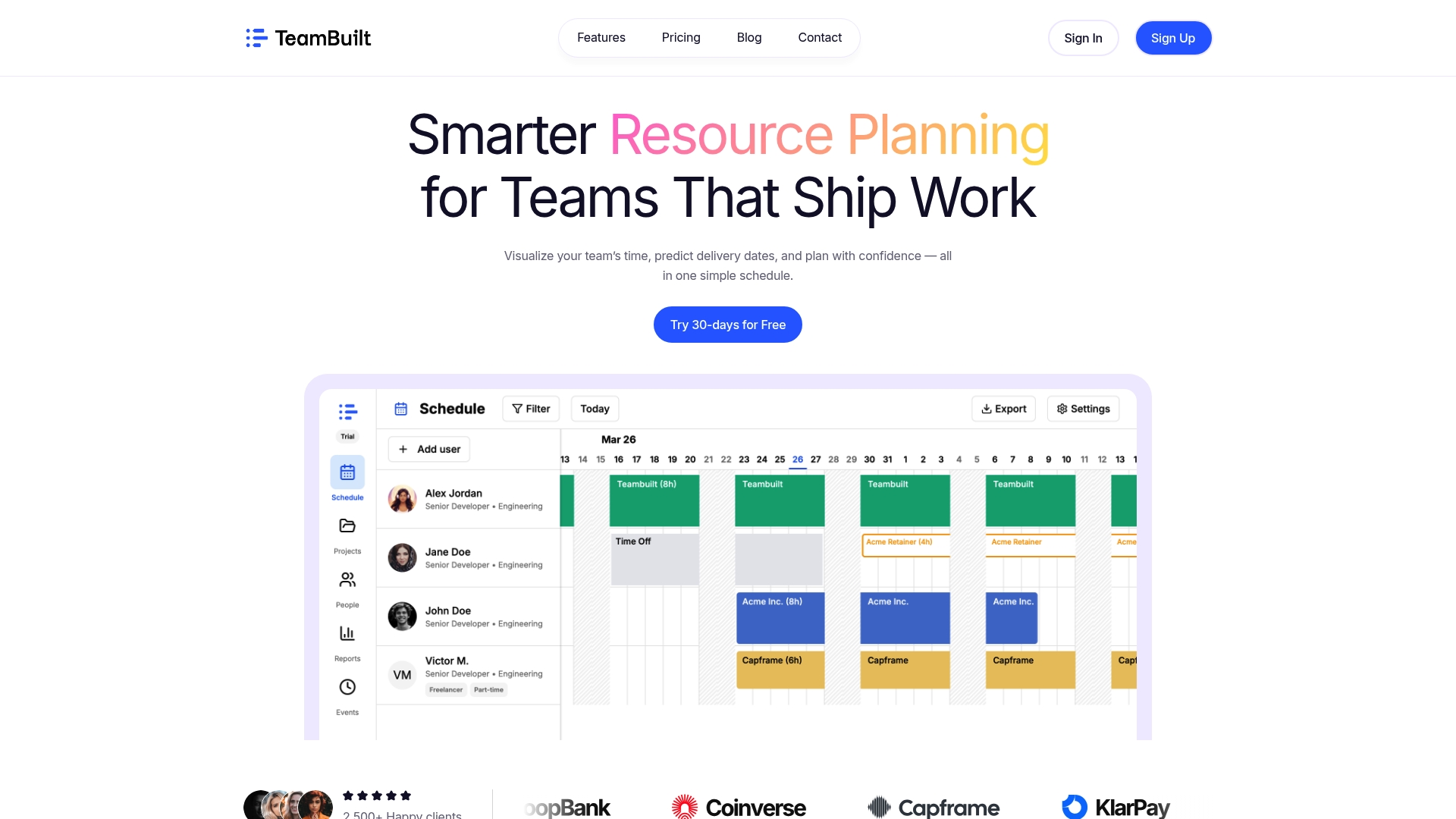
TeamBuilt gives HR professionals and team leads real-time visibility into team capacity, workload distribution, and project timelines, all in one place. Instead of piecing together data from spreadsheets and calendar apps, you get a centralized view that shows you who is available, where bottlenecks are forming, and when your next hire needs to be in place. Explore TeamBuilt’s features designed specifically for growing startups and SMBs that need smart, collaborative planning without enterprise-level complexity.
Frequently asked questions
What are the main steps HR should follow in team planning for a growing business?
HR should assess the current team, forecast future needs, analyze gaps, develop hiring or training plans, and regularly review and adjust to business changes. The core HR planning process covers all five steps in sequence.
How often should small businesses update their team plans?
Quarterly is a solid baseline for most small businesses, but high-growth startups should review plans monthly since roles and priorities shift faster than annual or biannual cycles can capture.
What is the benefit of data-driven HR planning?
Data-driven planning reduces payroll variance and improves hiring accuracy. One structured planning case study showed variance dropping from 12% to 4% and $3 million in savings as a direct result.
Is strategic or operational team planning more common among small businesses?
Most small companies focus on short-term operational planning, but only 12 to 23% of organizations do strategic workforce planning with a 3 to 5 year horizon, which is where the real competitive advantage lives.
How can lean teams manage HR functions without a full-time HR professional?
Virtual or fractional HR services are an effective solution for lean teams. Pairing that with simple, prioritized onboarding processes ensures new hires contribute quickly without overwhelming the existing team.
Recommended
- How to plan resources for SMB success: steps, tools, tips | Teambuilt Blog
- Step-by-step team scheduling: optimize projects fast | Teambuilt Blog
- Boost Team Productivity: 5 Proven Workflow Examples for SMBs | Teambuilt Blog
- Boost Team Productivity: 5 Proven Workflow Examples for SMBs | Teambuilt Blog
- Top AI tools for startups: boost productivity in 2026 – AI Management Agency
- Inspire Wellness: Top Employee Wellbeing Programs Dubai