
Project Management for Agencies: What Leaders Must Know


TL;DR:
- Effective agency project management involves structured coordination across multiple clients, emphasizing planning, communication, and clear roles. Implementing RACI, shared backlogs, and routine prioritization enhances transparency, reduces scope creep, and improves team efficiency. The use of tailored tools like Teambuilt supports deliberate workflows, enabling agencies to deliver consistent, predictable results.
Agency projects fail quietly. A client brief gets misread, a designer starts building before copy is approved, and by the time anyone notices, the deadline has passed and the budget is gone. Understanding what is project management for agencies, specifically how it differs from generic project management, is what separates agencies that grow from those that churn through clients.
Table of Contents
- Key takeaways
- What is project management for agencies
- Roles and accountability in agency projects
- Shared backlogs and prioritization cadences
- Common challenges in agency project management
- Best practices and software for agency project management
- My take on why most agencies get this wrong
- How Teambuilt helps agencies run tighter projects
- FAQ
Key takeaways
| Point | Details |
|---|---|
| Agency PM is distinct | Agencies juggle simultaneous clients, shifting scopes, and cross-functional teams, requiring tailored workflows. |
| Five process groups apply | Initiating through closing gives every project a structured path from client brief to final delivery. |
| RACI prevents chaos | Assigning clear ownership at every decision point stops confusion during handoffs and client approvals. |
| Visible backlogs build trust | Shared, prioritized work queues reviewed weekly shift teams from reactive firefighting to deliberate planning. |
| Software is underused | Only 23% of agencies use project management software, yet it directly reduces cost overruns and missed deadlines. |
What is project management for agencies
Project management is the practice of guiding work through five phases: initiating, planning, executing, monitoring and controlling, and closing. That definition applies universally. What makes it specific to agencies is the environment those phases operate in.
Agencies carry multiple clients simultaneously. A creative agency might be running a brand refresh, a product launch campaign, and an ongoing content retainer at the same time, with much of the same team. The project management discipline that works in a single-product software company, where one team owns one roadmap, breaks down fast in that context.
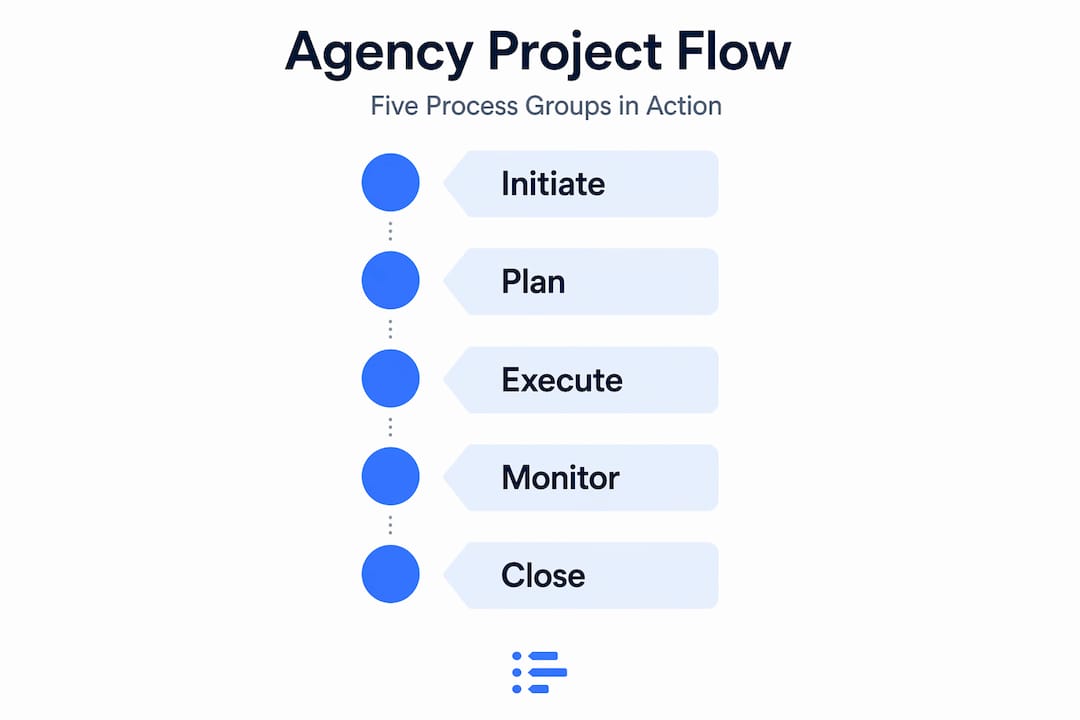
Agency project management, sometimes called client services delivery management, refers to the structured coordination of people, timelines, budgets, and client expectations across multiple concurrent engagements. It is not just task tracking. It covers scope definition, resource allocation, quality control, stakeholder communication, and risk management, all adapted to the rhythms of client work.
The five process groups in practice
Here is how each phase looks inside an agency:
- Initiating. A signed contract triggers a kickoff meeting. The project manager defines scope, identifies stakeholders, and sets a delivery timeline aligned to the client’s brief.
- Planning. The team maps tasks, assigns owners, estimates hours, and flags dependencies. A content campaign might require strategy, copywriting, design, legal review, and client approval before anything goes live.
- Executing. Work begins. The PM coordinates across disciplines, removes blockers, and keeps the client informed at agreed intervals.
- Monitoring and controlling. Weekly check-ins, budget tracking, and scope reviews happen here. Any change request gets logged and evaluated before work shifts.
- Closing. Final deliverables are approved, retrospectives are held, and invoices go out. Lessons feed the next project.
This structure matters because scope, time, resources, risks, and quality must all be managed in parallel, not sequentially. Skipping the planning phase to move faster almost always costs more time by the execution phase.
Roles and accountability in agency projects
Agencies have a role clarity problem. Account managers, project managers, creative directors, and department leads all feel some ownership over a project. Without a defined structure, every person assumes someone else is handling the thing that eventually falls through the cracks.
The RACI framework is the most widely adopted solution. It assigns one of four labels to each person involved in a task or decision. RACI stands for Responsible, Accountable, Consulted, and Informed. Responsible does the work. Accountable owns the outcome and makes the final call. Consulted provides input before decisions. Informed receives updates after decisions.
How agencies apply RACI in practice
Consider a client presentation approval. The account manager is Accountable: the client relationship is theirs. The copywriter and designer are Responsible: they built the deck. The creative director is Consulted: their creative standards must be met. The agency owner and media buyer are simply Informed. That single clarity eliminates three common agency arguments before they start.
The most common RACI mistake is assigning multiple Accountable parties. One task, one Accountable owner is the rule without exception. When two people share accountability, neither of them truly has it.
Pro Tip: Keep your RACI matrix inside your project management tool, not in a Google Doc that lives in someone’s Drive. Shared RACI visibility means every team member can see who owns what, removing the “I didn’t know it was my job” excuse entirely.
Agencies also make the mistake of treating RACI as a one-time setup. Projects evolve. A scope change in week three can completely shift who is Responsible for what. Revisit the matrix at every major milestone and any time scope or team composition changes.
| Scenario | Accountable | Responsible | Consulted | Informed |
|---|---|---|---|---|
| Client approval on creative | Account manager | Designer, copywriter | Creative director | Agency owner |
| Campaign go-live decision | Project manager | Developer, media buyer | Account manager | Client stakeholder |
| Scope change evaluation | Account manager | Project manager | Creative director | All team leads |
Shared backlogs and prioritization cadences
Most agencies operate from someone’s head. A senior account manager knows the priority order because they live it. No one else does. When that person is out sick or leaves, the team loses its operating system overnight.

A shared backlog, meaning a single visible list of all active and queued work across every client and project, solves this. Teams with visible work systems report 76% confidence in smooth operations, compared to just 61% for teams without them. That gap in confidence translates directly to fewer missed handoffs and less client frustration.
The mechanics are straightforward:
- Every piece of work, no matter how small, lives in one place
- Work is ranked by priority, not by who asked loudest
- The full team can see what is coming and what is on hold
- Nothing gets started without a deliberate prioritization decision
The recommended cadence for reviewing and reprioritizing that backlog is every one to two weeks. This shifts the team from reactive to deliberate. Instead of scrambling when a new client request arrives, the PM holds a brief reprioritization session where the team decides what moves up, what moves down, and what gets parked.
One often-overlooked part of this: protecting bandwidth for strategic work. Reserving 10 to 15% of team capacity for planning, process improvement, and proactive strategy, rather than filling every hour with client execution, directly improves the quality of the agency’s output. Agencies that bill every hour they have rarely make time to improve how they work.
Pro Tip: Use your backlog review to explicitly call out what you are NOT doing this week. Visible deprioritization builds as much trust with your team as visible prioritization does. When people see that something was deliberately moved back, rather than just forgotten, the whole team operates with more confidence.
Common challenges in agency project management
Nearly 54% of agencies have not made project management a real part of their culture. The result shows up in predictable ways.
Here are the four most common problems, and what actually fixes them:
-
Scope creep. 52% of projects experience scope creep. The fix is not just having a change request process. It is defining scope so precisely at the start that both the client and the team agree on what is and is not included. Ambiguity is where scope creep breeds.
-
Communication breakdown. When client updates happen over email, Slack, and calls simultaneously, no one has the full picture. Centralizing communication inside a project platform, with structured update formats, reduces errors and missed deadlines more reliably than any policy memo.
-
Resource mismanagement. Agencies overbook their best people because no one can see across all projects at once. A resource planning tool that shows capacity by person, by week, prevents the situation where a senior designer is at 140% utilization on Tuesday and the account manager does not find out until a deadline is missed.
-
Client expectation gaps. These do not usually come from clients changing their minds. They come from the agency never explicitly agreeing on what success looks like. Define measurable outcomes at kickoff, document them, and revisit them at every review point.
Good project delivery practices treat risk management as a standing agenda item, not a reaction to a crisis.
Best practices and software for agency project management
Project management for marketing agencies and other client-serving firms works best when structure and software reinforce each other. The discipline without the tools creates paperwork. The tools without the discipline create digital clutter.
Key capabilities agencies need in a project management platform:
- Workload visibility. Can you see who is over or under capacity across every project this week and next?
- Timeline forecasting. Does the tool update estimated delivery dates when resources change?
- Centralized communication. Are client updates, approvals, and feedback logged in the same place as the work?
- Cross-team coordination. Can different departments see how their work connects to the broader project?
| Feature | Why it matters for agencies |
|---|---|
| Resource capacity tracking | Prevents overbooking and identifies availability before committing to deadlines |
| Real-time workload visualization | Surfaces conflicts across simultaneous client engagements |
| Shared backlog management | Keeps prioritization decisions visible to the whole team |
| Client approval workflows | Creates a structured record of what was approved and when |
| Integration with existing tools | Reduces manual updates between platforms |
Beyond tools, the best practices for agency project management come down to culture. Scalable agency workflows require buy-in from everyone, not just project managers. When account managers, creatives, and operations leads all work from the same system, the overhead of chasing updates drops significantly. Training should be ongoing, not a one-time onboarding event.
My take on why most agencies get this wrong
I have watched a lot of agencies treat project management as a role to hire for rather than a system to build. They bring in a project manager, hand them a mess, and expect order to emerge. It rarely works that way.
What actually changes things, in my experience, is when agency leadership decides that visibility is a non-negotiable. Not visibility as in surveillance, but visibility as in everyone knows what is being worked on, why it is prioritized, and who owns each decision. The moment that becomes the norm, the reactive scrambling starts to quiet down.
The RACI frameworks and backlog cadences are not bureaucracy. They are what makes it possible for a team of twelve people to serve eight clients without anyone losing their mind. The agencies I have seen thrive are the ones that treat these structures as tools for creative freedom, not as constraints on it.
I have also seen agencies skip the closing phase almost universally. A project ends, the client is happy, and the team immediately shifts to the next thing. No retrospective, no lessons captured, no process improvement. Then they make the same scope creep mistake three months later and wonder why. The cross-team coordination that makes agencies great does not happen by accident. It gets built through deliberate review and iteration.
The agencies that grow sustainably are not the ones with the most talented people. They are the ones who know how to repeat what works.
— Dima
How Teambuilt helps agencies run tighter projects
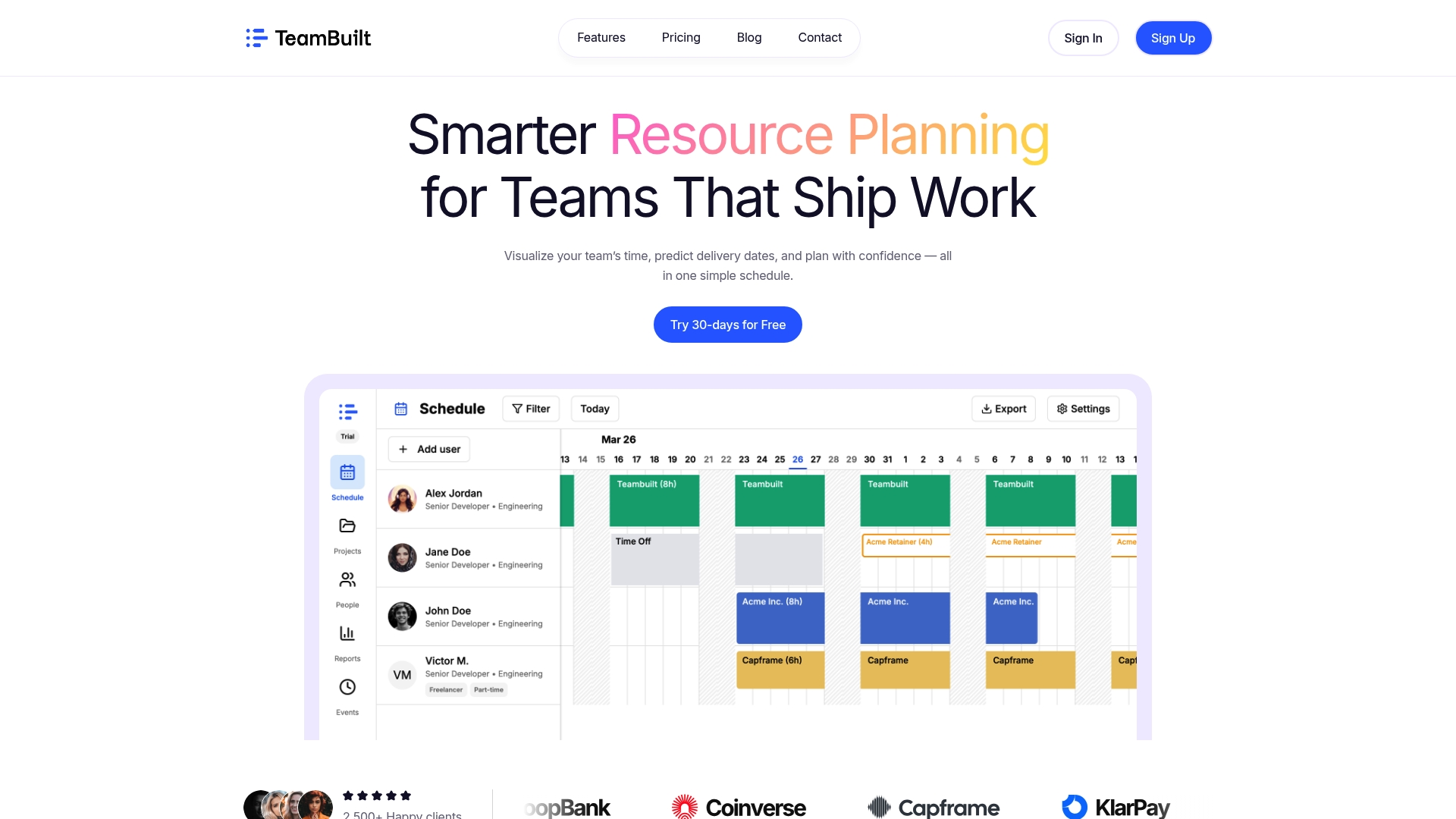
Teambuilt was built specifically for the kind of complex, multi-team environments that agencies live in every day. The platform gives project managers real-time visibility into team capacity, so you can commit to deadlines knowing you actually have the bandwidth to meet them. Workload visualization catches resource conflicts before they become client problems. Shared backlogs and timeline forecasting mean your whole team works from the same plan, not competing versions of it.
If you are ready to move your agency from reactive project delivery to deliberate, repeatable execution, start with Teambuilt. You can also explore deeper guidance on faster project delivery through better team communication on the Teambuilt blog.
FAQ
What is project management for agencies?
Project management for agencies is the structured process of coordinating people, timelines, budgets, and client expectations across multiple concurrent engagements. It adapts standard project management phases, from initiating through closing, to the specific demands of client-service environments.
Why do agencies use project management software?
Only 23% of agencies currently use project management software, but those that do report fewer cost overruns, better deadline adherence, and improved client communication. Software provides the centralized visibility that agencies cannot achieve with spreadsheets and email threads.
What is RACI and how does it apply to agencies?
RACI is a responsibility assignment framework that labels each team member as Responsible, Accountable, Consulted, or Informed for every task or decision. In agencies, it prevents the confusion that arises during client handoffs, approval workflows, and cross-department collaboration.
How often should agencies reprioritize their project backlog?
Agencies should review and reprioritize their shared backlog every one to two weeks. This cadence shifts teams from reacting to every new client request toward deliberate, transparent planning that the whole team can see and trust.
What are the biggest project management challenges agencies face?
Scope creep, communication breakdowns, resource mismanagement, and unclear client expectations are the most common problems. Each one can be reduced significantly through defined scope documentation, centralized communication, capacity tracking, and structured kickoff processes.
Recommended